A faint red outline on a limestone wall in Indonesia has changed how early human creativity is understood. Researchers have identified a hand stencil that dates back at least 67,800 years, making it the oldest cave art ever recorded.
The discovery adds a major piece to the puzzle of when humans first began creating symbolic images and how early those skills developed outside Europe.
The ancient hand stencil was found inside Liang Metanduno, a limestone cave on Muna Island, located off the eastern coast of Sulawesi, Indonesia. Though the image is faded and easy to miss, careful study revealed its age and importance. Indonesian and Australian researchers confirmed that one stencil inside the cave predates all previously known cave art.
This finding supports growing evidence that Southeast Asia played a major role in early human artistic expression. Until recently, Europe dominated discussions around prehistoric art origins, largely due to discoveries in France and Spain dated between 30,000 and 40,000 years ago.
How the Hand Stencil Was Created
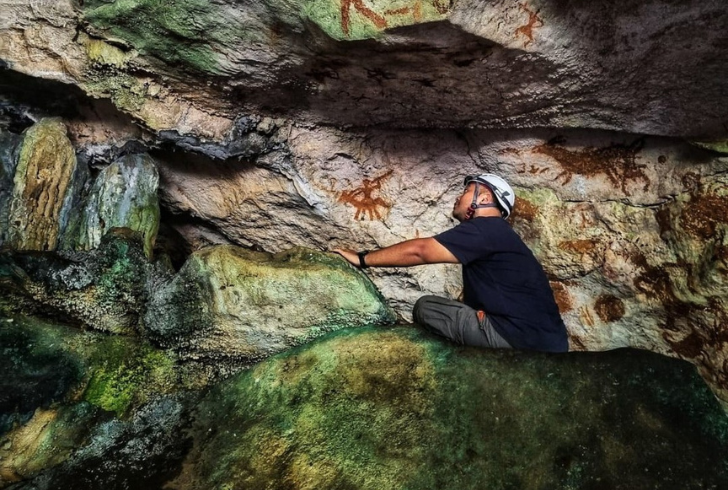
Instagram | theleakeyfoundation | Researchers found a 67,800-year-old hand stencil in Indonesia, marking the oldest recorded cave art.
The hand stencil was formed using a simple but deliberate method. Pigment was blown onto a hand pressed flat against the cave wall, leaving a clear outline once the hand was removed.
Close examination reveals several notable characteristics. The fingers appear deliberately reshaped to give them a pointed form, reinforcing the impression that the markings were made by human hands rather than resembling animal shapes. This visual approach also reflects early symbolic marking practices, indicating purposeful artistic expression rather than random markings.
Researchers believe the hands may belong to early humans connected to the ancestors of the first Australians.
Dating the World’s Oldest Cave Art
Dating cave art often presents challenges. In this case, scientists analyzed mineral crusts that slowly formed over the stencil. These layers act like a natural timestamp. By measuring them, the team determined the minimum age of the artwork.
Adam Brumm, professor of archaeology at Griffith University in Brisbane and co-author of the study published in Nature, highlighted the importance of the result.
“This is pretty extraordinary, because usually rock art is very difficult to date, and it doesn’t date back to anywhere near that old,” Brumm said.
The newly dated hand stencil is more than 15,000 years older than another major discovery by the same team. In 2024, researchers dated a cave painting on Sulawesi showing three human-like figures interacting with a pig to around 51,200 years old.
Reflecting on the comparison, Brumm said:
“I thought we were doing pretty well then, but this one image just completely blew that other one away.”
He added:
“It really just shows how long people have been making rock art in that part of the world. It’s a very long time.”
A Site Hiding Art in Plain Sight
Liang Metanduno is not a newly found cave. It has long been open to tourists and known for paintings of chickens and other domesticated animals, dated to around 4,000 years ago. The ancient hand stencils remained hidden behind these later artworks.
In 2015, Indonesian rock art specialist Adhi Oktaviana, the study’s lead author, noticed faint shapes beneath newer paintings. Those shapes turned out to be the ancient hand stencils.
Brumm explained the moment clearly:
“No one had ever observed them before. No one even knew that they were there. But Adhi spotted them.”
Shifting the Focus Beyond Europe
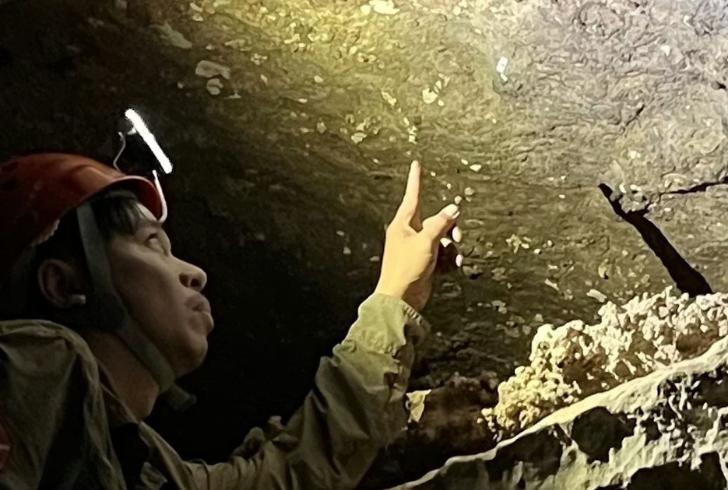
Instagram | theleakeyfoundation | Evidence shows Indonesian cave art originated long before European human migration.
For decades, Ice Age cave paintings in Europe were viewed as the starting point of human artistic culture. That view is now changing.
According to Brumm, discoveries in Indonesia show that humans outside Europe were creating highly detailed cave art tens of thousands of years earlier, even before modern humans reached Europe.
This shift broadens the understanding of early human behavior and shows that creativity emerged in multiple regions, not just one.
The discovery also has implications for understanding when humans reached Australia. Aboriginal peoples are widely accepted to have lived there for at least 50,000 years. However, one archaeological site suggests human presence as early as 65,000 years ago.
Brumm linked the new finding directly to this debate:
“Now that we’re finding rock art dating to 67–68,000 years ago on the island of Sulawesi, which is essentially on Australia’s doorstep, it does make it considerably more likely that modern humans indeed were in Australia at least 65,000 years ago.”
Ongoing Exploration in Indonesia
Large parts of Indonesia remain archaeologically unexplored. Researchers hope to uncover even older examples of cave art, including images that show storytelling or complex social scenes. Each new discovery adds depth to the understanding of early human life in the region.
The 67,800-year-old hand stencil from Liang Metanduno reshapes the global story of human creativity. It confirms that symbolic expression began far earlier than once believed and developed across different regions at the same time.
As exploration continues across Indonesia, more findings may further change how early human history is understood.