When does fashion become art? The question continues to challenge historians, designers, and museum curators alike. At The Museum at FIT, the exhibition Art X Fashion addresses this debate through more than 140 objects that span centuries, movements, and mediums.
Curated by Dr. Elizabeth Way, the show examines how apparel moves beyond function and commerce to enter cultural and artistic conversations.
As New York City’s only museum dedicated entirely to fashion, the institution positions clothing as a serious cultural artifact. This exhibition does not dictate answers. Instead, it encourages viewers to consider how creative intention, craftsmanship, and historical context shape the way fashion is understood.
When Does Fashion Qualify as Art?
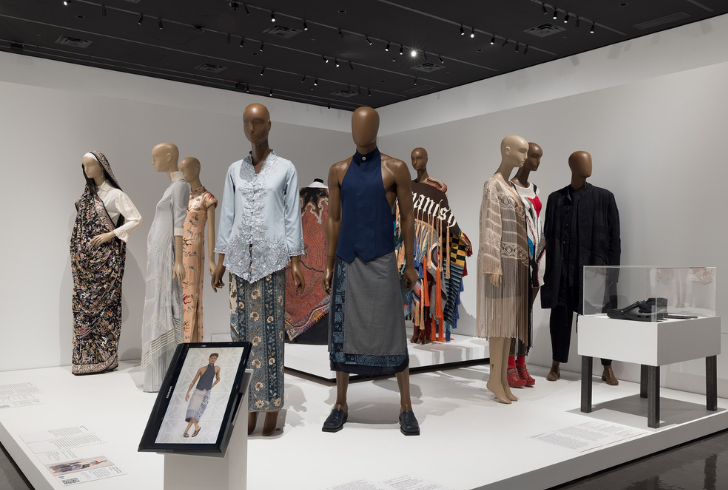
Instagram | museumatfit | FIT explores the blurred lines between fashion and art across centuries of design.
Dr. Elizabeth Way draws an important line between fashion and art. In her view, the two are not automatically the same. Western art traditions—particularly those shaped during the Renaissance—created a clear hierarchy. Painting, sculpture, and architecture were elevated as “high art,” while decorative practices sat lower in the ranking. Many of those decorative fields were also linked to work historically done by women. Fashion, connected to clothing and everyday life, rarely received the same recognition.
Art was usually framed as something intellectual or spiritual. Clothing, because it is worn and practical, was treated as functional rather than expressive. That division, however, invites debate.
Some key questions help frame the conversation:
- Emotional impact – Does the garment spark a strong visual or emotional reaction?
-
Creative intent – Is the designer using the piece to explore identity, ideas, or innovation?
-
Function vs. expression - When clothing moves beyond practical use, perception shifts.
Art often exists without a practical purpose. When fashion approaches that realm—less about wearability, more about concept—it aligns more closely with fine art.
Designers Who Blurred the Line
Certain creators have consistently challenged traditional boundaries.
Iris van Herpen
Her designs often take on sculptural, almost organic shapes. At times, they feel closer to architecture than traditional clothing. Movement becomes the central idea, while practicality fades into the background. Even when wearability seems secondary, the garments succeed visually.
Elsa Schiaparelli
Elsa Schiaparelli approached fashion as a form of artistic experimentation. In the 1930s, she collaborated with painters and embraced the surrealist movement. One famous example is the perfume bottle Le Roy Soleil, created in 1946 with Salvador Dalí and the glassmaker Baccarat. The object shows how fashion and avant-garde art could intersect directly.
That period often looks glamorous or dreamlike in hindsight. In reality, Europe was facing deep political uncertainty. Surrealism’s fascination with the subconscious reflected that tension. Fashion responded in its own way, offering beauty while quietly echoing the anxiety of the era.
Modernity and Artistic Lifestyle in the 1920s
The 1920s brought a completely different energy. New art movements began influencing clothing design in visible ways.
Paul Poiret
Poiret frequently worked alongside artists, including Raoul Dufy. His textiles were filled with bold color, reflecting the experimentation of Fauvist painting. His interest in Orientalism was also shaped by connections to Sergei Diaghilev and the Ballets Russes.
Through fashion, interior design, and elaborate social events, Poiret promoted a broader artistic lifestyle. Art began moving beyond small avant-garde circles and into everyday public culture.
Sonia Delaunay
Delaunay operated seamlessly between painting, textile design, and fashion. She rejected strict divisions between fine art and commercial practice. Her exploration of color vibration informed both canvases and garments. For Delaunay, fashion was not secondary—it was integral.
Art Reproduced on Apparel
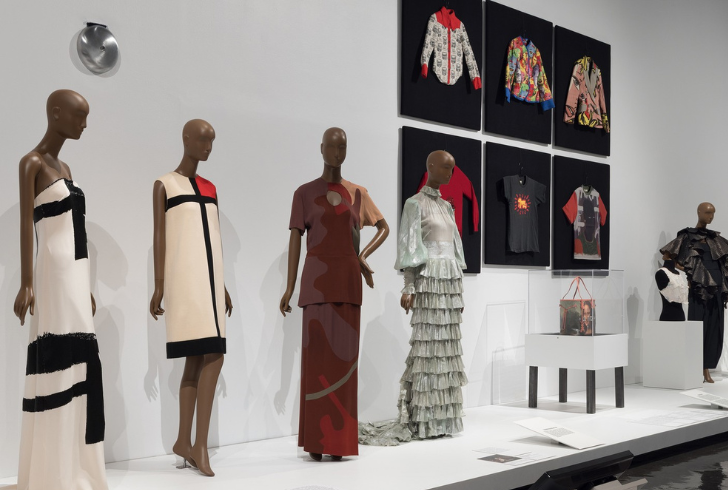
Instagram | museumatfit | Designers like Versace and Wales Bonner transform iconic fine art into modern fashion.
The exhibition also explores how iconic artworks move from gallery walls to garments.
Gianni Versace reinterpreted Andy Warhol’s 1967 Marilyn Monroe imagery on tailored pieces, while Franco Moschino drew from the bold comic-style visuals of Roy Lichtenstein. In a more contemporary exchange, Grace Wales Bonner collaborated with Kerry James Marshall, placing fine art directly into modern apparel.
Pop art interpretations often bring humor and a sense of openness to fashion. They make artistic references feel approachable rather than distant. At the same time, some collaborations extend beyond style and support social causes. Wales Bonner and Marshall, for example, reproduced Lost Boys: AKA Black Sonny (1993) on a T-shirt, using the project to raise funds for organizations that assist formerly incarcerated individuals.
Keith Haring worked in a similar spirit. He frequently used commercial formats to help finance his broader artistic projects. In many cases, the meeting point between art and fashion allows creative experimentation to continue by generating commercial support.
Artists Who Designed to Survive
Many artists move between mediums out of necessity as well as curiosity.
Boris Lurie, for instance, created fashion illustrations and textile designs to help sustain his multimedia art practice. That commercial work did not weaken his artistic identity. Instead, it helped keep it alive.
The arrangement resembles the structure of couture houses. Accessible products generate revenue that supports the more experimental work seen on the runway.
Black Designers and Artistic Education
The exhibition also features work by Scott Barrie, Fabrice, Eric Gaskins, and WilliWear, the label founded by Willi Smith. Their presence highlights the importance of art education and cross-disciplinary training in shaping fashion design.
Barrie drew on life-drawing techniques to shape body-conscious silhouettes. Fabrice moved from painting into clothing, beginning with hand-painted garments before translating those visual ideas into complex beadwork. Eric Gaskins looked to Franz Kline for inspiration, recreating the energy of the painter’s brushstrokes through careful hand-beading.
Here, the relationship between flat composition and three-dimensional form becomes essential. Technical craft turns artistic influence into structural design.
The Mondrian Dress and Youth Culture
Few garments illustrate this dialogue better than the 1965 Mondrian dress by Yves Saint Laurent. Inspired by Piet Mondrian’s geometric compositions from the 1930s, the dress translated flat abstraction into a sculpted silhouette.
Key technical accomplishments involved removing curved seams to maintain the integrity of graphic lines, combining traditional couture craftsmanship with modern minimalist design, and connecting the principles of fine art history to a fashion culture shaped by youth and contemporary trends.
The design coincided with the “youthquake” era, when fashion reflected social change. Saint Laurent demonstrated that modernity and tradition could coexist.
Wearability and Artistic Intent
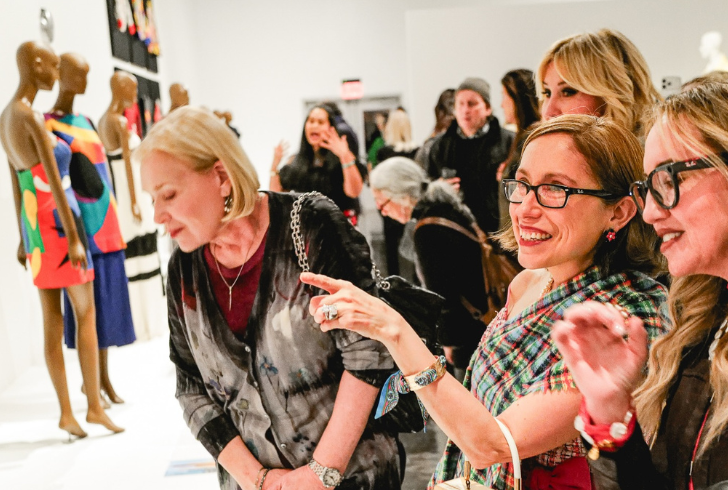
Instagram | bfa | MFIT highlights how modern innovation challenges fashion’s historical subordination to fine art.
Perception of “wearable” varies widely. Some viewers see exaggerated forms as impractical. Others view them as conceptual achievements.
Designers such as Rei Kawakubo of Comme des Garçons present garments that challenge body expectations. When clothing communicates ideas beyond personal adornment, it approaches artistic territory.
Similarly, textile artist and designer Josh Tafoya integrates Rio Grande weaving traditions into structured apparel. Trained at Parsons and influenced by Taos heritage, Tafoya bridges gallery-level textile art and fashion construction.
Educational and Cultural Significance
The exhibition begins with a timeline linking major art movements—from Rococo to Post-Modernism—to parallel developments in fashion. Rather than suggesting fashion merely imitates art, it positions both as responses to shared cultural forces.
Students studying art history gain practical insight into how ideas circulate across mediums. Designers gain exposure to visual references that inform future collections. Visitors encounter garments as intellectual and cultural artifacts, not seasonal trends.
Admission to exhibitions at The Museum at FIT remains free, reinforcing accessibility to fashion scholarship.
Art X Fashion demonstrates that the boundary between art and apparel remains fluid. Historical hierarchies placed fashion below fine art, largely because of its functional nature and association with the body. Yet intention, innovation, and cultural commentary complicate that separation.
From Schiaparelli’s surrealist collaborations to Saint Laurent’s Mondrian translation, from Delaunay’s color theory to Tafoya’s woven garments, fashion repeatedly enters artistic discourse. When clothing carries conceptual weight, challenges perception, and demands emotional response, the distinction narrows.
The dialogue continues, shaped by creators who treat fabric as both material and message.